The tack, step by step
Look first: clear water on the new tack, no boat you would tack in front of, and full speed, so that she carries her way through the wind. Call “Ready about” and wait for the crew’s “Ready”: the old jib sheet in hand, the new one ready.
Call “Lee-oh” and put the helm over smoothly: a tiller pushed towards the sail, a wheel turned the way the bow is to go. As the jib starts to back, let its old sheet go and pull it in fast on the new side; the main comes across by itself. Straighten the helm as she comes onto close-hauled on the new tack. Then trim: the sheets a touch eased until she picks up speed, in hard once she has.
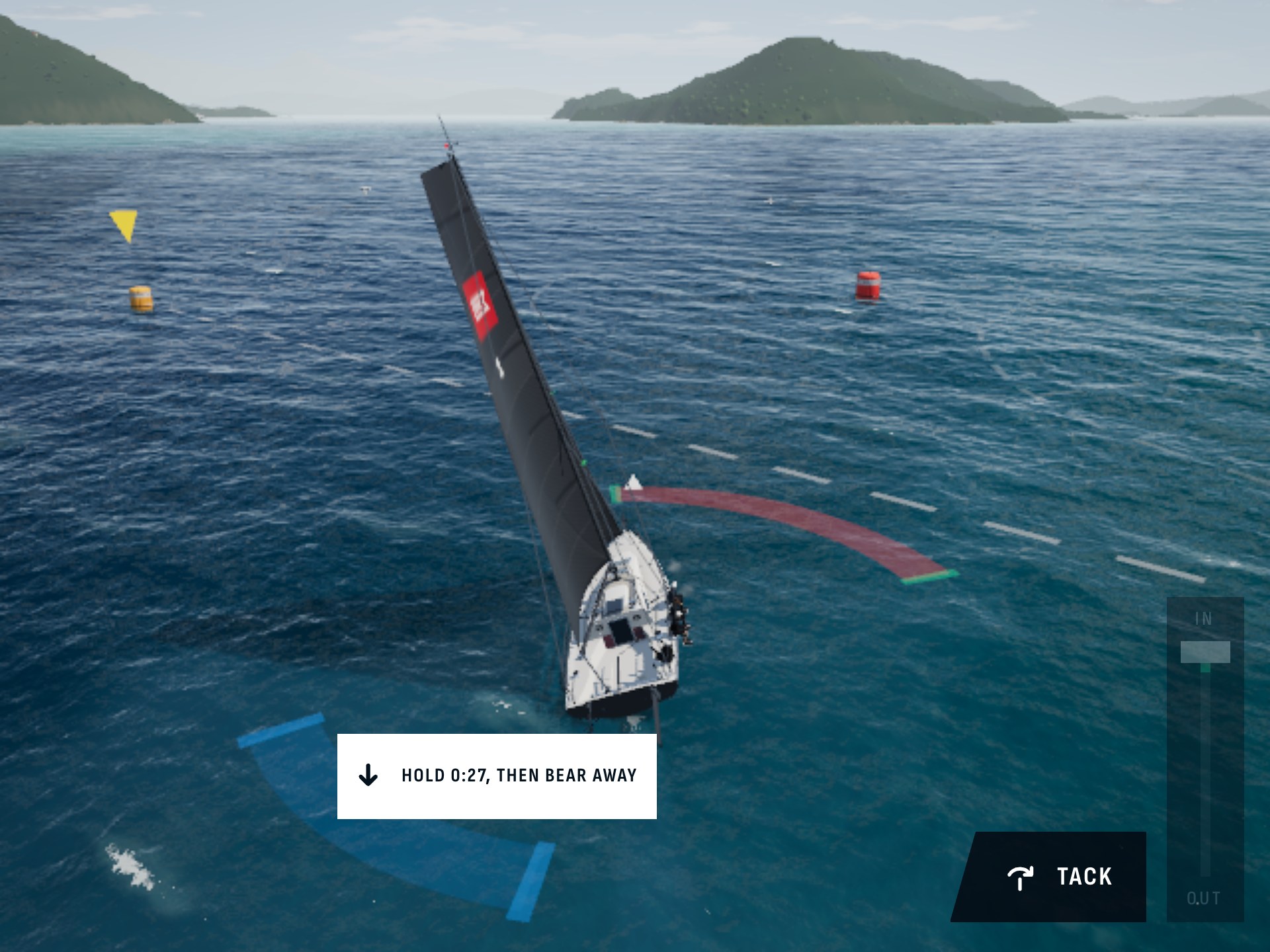
In the game, Tack — the button, or Space on a keyboard — does all of it: she turns to the same angle to the wind on the other tack and the crew calls it. Tacking by hand with the steering works too.
How far, and keeping speed
From close-hauled to close-hauled most boats turn through about 80° to 90°, twice their angle to the wind. Turn too slowly and she loses her way before the bow is through, and stops head to wind, in irons. Turn too hard and the rudder, across the flow, brakes her. A smooth, steady turn loses least; in waves, tack on a flat patch.
Every tack costs speed, and building it again takes a while: longer in light air and in a heavy boat. Come out a few degrees below close-hauled with the sheets a little eased, let her accelerate, then head up to her proper angle. In light air, tack less.
Dinghy sailors roll tack: they heel her to windward as she turns, which helps her round, then cross and flatten her hard on the new side, which flicks the sail and gets her going. Rule 42 allows it, as long as she comes out no faster than she would have been without the tack.
There is no roll tack in the game. The Laser and the Optimist stop in a tack and go again at once; the J Class takes some three times as long as the JPK 1050. Come out of a tack slow and the game tells you to foot.
The gybe, step by step
Look first: clear water on the new gybe, and every head clear of the boom’s path. Call “Stand by to gybe”; on a keelboat the crew pull the main in towards the middle, so the boom has less far to swing.
Call “Gybe-oh” and bear away steadily. As the stern passes through the wind the boom comes across — in a dinghy, help it with a tug on the mainsheet — and everyone ducks. The moment it crosses, meet her with the helm: with the main filling on the new side she wants to round up. Let the main out on the new side, bring the jib across, and settle on the new course.
In the game the same button gybes once the wind is more than about 95° off the bow, and then reads Gybe. Steer through dead downwind by hand instead, turning steadily, and the crew brings the boom across as you go.
Avoid the crash gybe
A crash gybe is one you didn’t mean. Sailing by the lee, past dead downwind, the wind gets behind the main and throws the boom across at full speed. It can hurt anyone in its way and break gear, and in a breeze it lays the boat over and spins her round.
The warnings come first: the jib goes limp and floats across, the wind indicator at the masthead points to the boom’s side, the boom starts to lift. Head up a few degrees and they stop. Keep the kicker on to hold the boom down, and on a cruiser rig a preventer for a long run.
The game warns you, “By the lee”, with the degrees. Drift on by the lee without turning and the boom comes across on its own: in a breeze she heels hard and slows, and with the gennaker up she can roll and round up.
Tack or gybe?
Upwind, tack: to gybe from close-hauled you bear away through a run and come all the way back up, some 270° of turning and a lot of ground lost to leeward. Downwind, gybe, for the same reason the other way round. On a reach either will do: tack from a close or a beam reach, gybe from a broad one.
A tack is the gentler of the two, the boom crossing slowly with the sails flapping. In a blow, or with a new crew, turning the long way round through a tack — a “chicken gybe” — costs distance, not gear.
A penalty turn is one of each, a tack and a gybe, turning the same way (rule 44.2).
Keep clear while you tack (rule 13)
From the moment she passes head to wind until she is on a close-hauled course, a tacking boat keeps clear of everyone, on either tack (rule 13). Once on her new course she may have right of way, but must at first give the other boat room to keep clear (rule 15). A gybe has no rule of its own: she is on the new tack as soon as the boom comes across.
The computer boats in the game race by it: tack too close under their bows and they hail “You’re tacking — keep clear!”, and the foul is yours.
Tacking just ahead and to leeward of a boat, on her lee bow, puts her in your dirty air — but only if you are close-hauled before she has to change course to avoid you. A length short and it’s a foul.