The no-go zone
No sailing boat can sail straight into the wind. Point within about 40° to 45° of it on either side and the sails flap and she stops. That arc, some 90° wide, is the no-go zone; a boat stuck head to wind in it, unable to steer, is in irons.
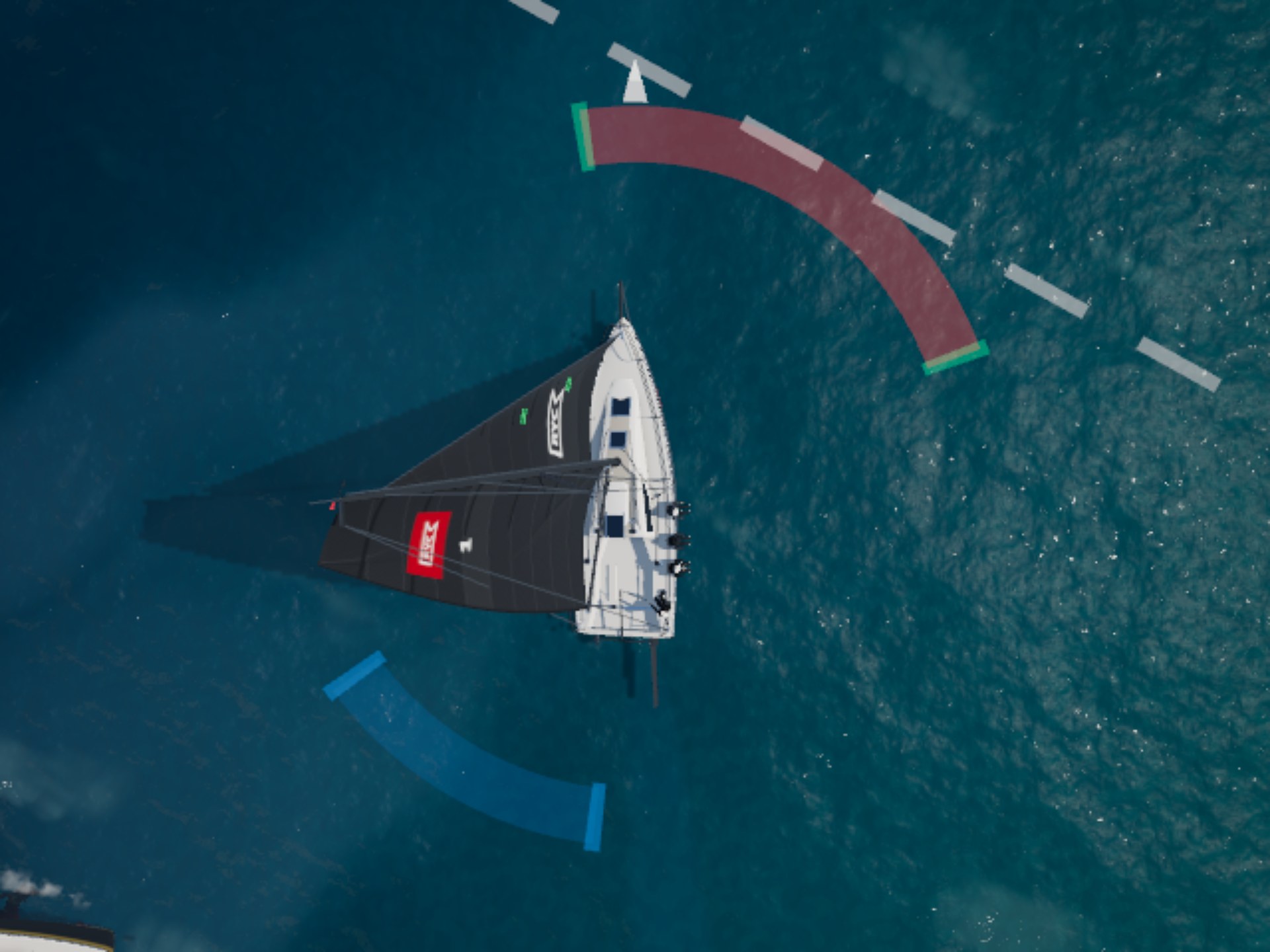
So to reach a mark that lies upwind she sails a zigzag, close-hauled on one tack and then on the other: a beat. In the game the red arc round your boat is the no-go zone for the wind you’re in, and the green marks at its ends are close-hauled on each tack.
In irons, let the sheets out and hold the jib out to one side: the wind pushes the bow off the other way, and once the sails fill you can pull them in and sail off. In the game, steer away from the wind.
Close-hauled and the close reach
Close-hauled is as near the wind as the boat sails well: about 45° off the true wind for most cruisers and dinghies, nearer 40° for a racing keelboat. The sails are pulled in hard, the boom near the middle of the boat and the jib close in. Point higher and she pinches: the front of the jib lifts, and she slows and slips sideways.
Bear away a little further and ease the sheets a little, and she is on a close reach: she points lower than close-hauled, but goes faster.
Steer close-hauled by the jib: head up until its front edge just starts to lift, then bear away a touch until it stops. That edge is the edge of the no-go zone, and it moves with every shift.
Reaching: beam and broad
A reach is a course across the wind. On a beam reach the wind comes square over the side, at 90°, and the sails are let out about halfway. On a broad reach it comes over the back quarter, between the beam and the stern, and they go out further still, the boom well out over the side.
On any reach the way to set a sail is the same: ease it until its front edge just starts to flap, then pull it back in until it stops. In a dinghy the centreboard goes up as you bear away: all the way down close-hauled, about halfway on a beam reach, mostly up on a run.
In the game the Kite button sets the gennaker once the wind is more than 100° off the bow, and it comes down in a hurry if you head up much above a beam reach with it set.
Running
On a run the wind is behind you and the boat is pushed rather than pulled along. The main is let right out, the boom square across the boat, short of the shrouds. The jib, in the main’s wind shadow, goes limp: you can hold it out on the other side, goose-winged, or set a spinnaker or a gennaker instead.
Bear away past dead downwind and the wind gets behind the main from the other side: you are sailing by the lee, and the boom can come across on its own. So most boats, and all with an asymmetric gennaker, sail a few degrees either side of dead downwind and gybe between them.
In the game the blue marks round your boat are the best angle downwind on each gybe for the wind you’re in; between them, dead downwind, she is slower.
True and apparent wind
The true wind is the one you feel standing still. Once the boat moves she makes a wind of her own, from dead ahead, as you feel on a bicycle, and the two together are the apparent wind: the one the sails feel and the masthead wind indicator shows. It always blows from further forward than the true wind, except dead downwind. Upwind and across the wind it is stronger; downwind it is weaker, which is why a run feels gentler than it is.
The sails are trimmed to the apparent wind, so it moves the sheets. As she speeds up it swings forward and you pull in. In a gust it swings aft for a moment: upwind she can point a little higher, downwind go a little deeper. The faster the boat, the further forward it comes: the AC75 in the game, on her foils, sails at three times the wind’s speed, and her apparent wind stays ahead even heading downwind.
The wind in a forecast is the true wind. In the game the sheet’s green band follows the apparent wind; the wind box and the ring round your boat show the true.
Which point of sail is fastest
For most boats it is a reach. With the wind across her, more of the sails’ force drives her forward and less pushes her sideways than close-hauled, and the apparent wind is still strong. A heavy displacement boat is fastest about on the beam; a light one with a gennaker, in a breeze, on a broad reach, where she can plane and surf.
In the game each yacht sails to her own speeds for every wind and angle. The J Class is fastest on a beam reach; the JPK 1050 with the wind some 110° to 135° off, further aft the harder it blows. For every one of them, the dead run is the slowest way downwind.
Fastest isn’t quickest to the mark. Upwind and downwind what counts is VMG, your speed towards the wind or away from it, and it is best close-hauled and at a downwind angle, not on the reaches between. The game shows your VMG with your speed.